
Back to work
Workflow AutomationOperations Platform

Relay

An intelligent automation fabric that eliminates the manual work silently consuming 40% of your operations team's capacity.

Timeline

11 Weeks

Team

Team of 4

Reduction in Manual Operations Work

52%

Teams Running Production Workflows

1,800+

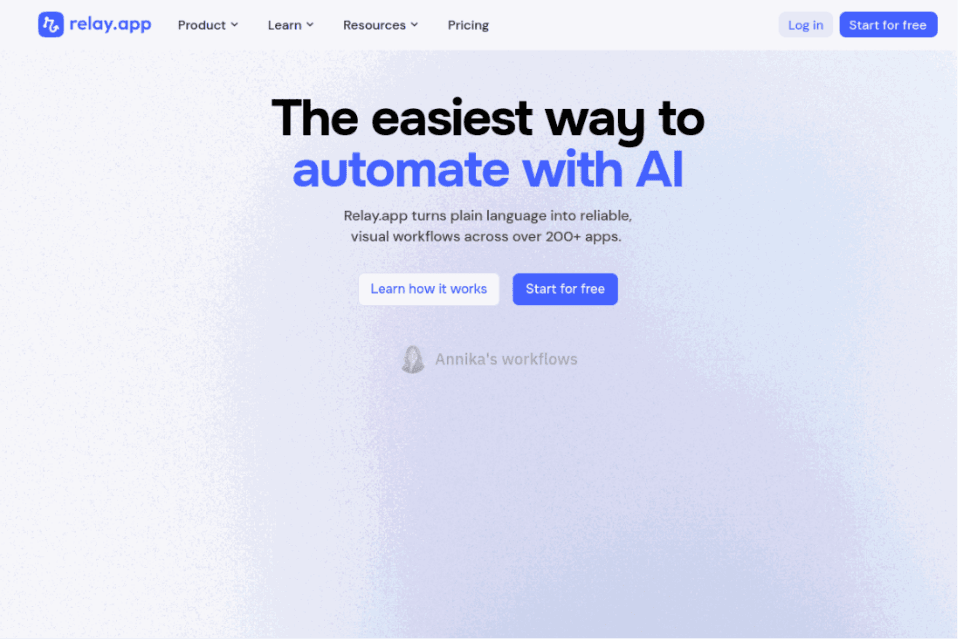
Relay product interface

Overview

Built for outcomes, not just interfaces.

Relay is a visual workflow automation platform engineered for operations-heavy teams that have outgrown manual processes but don't have the engineering bandwidth to build custom integrations. We built a system where non-technical operators can automate multi-step, cross-tool workflows — with the reliability and failure recovery guarantees of a production-grade integration layer underneath.

52%

Reduction in Manual Operations Work

1,800+

Teams Running Production Workflows

99.96%

Workflow Execution Reliability

01 — Challenge

The problem

A 35-person SaaS company had 12 operations team members spending a combined 68 hours per week on work that was documented, repeatable, and automatable: lead enrichment, CRM updates, Slack notifications, invoice generation, and onboarding task creation. The workflows existed in spreadsheets and tribal knowledge. Two team members had left and taken critical process context with them. The cost: $190K/year in pure capacity overhead.

02 — Approach

Our strategy

We designed Relay with a non-negotiable constraint: if a workflow failed, the operator had to know immediately and the system had to recover gracefully — not silently drop data. Most automation tools treat failure as an edge case. We treated it as the primary design constraint. Every workflow has retry logic, failure notifications, and a recoverable state log. Trust in the system is the product.

Solution

What we shipped

We delivered a node-based visual workflow builder with 200+ native integrations, conditional branching, multi-step error handling with automatic retries, and a full execution audit log. Workflows trigger on webhooks, schedules, or in-app events. A team-shared workflow library enables institutional knowledge to live in the system, not in people's heads.

  • Visual Node-Based Builder

    Drag-and-connect workflow editor with live execution preview and step-by-step debugging

  • 200+ Native Integrations

    Pre-built connectors for HubSpot, Slack, Stripe, Notion, Airtable, and 195+ more

  • Guaranteed Execution

    At-least-once delivery with configurable retry logic and dead-letter queue for failed steps

  • Conditional Branching Engine

    Multi-path logic with filter nodes, data transformation, and merge gates

  • Workflow Execution Audit Log

    Full step-by-step replay of every workflow run with input/output at each node

Relay product detail

Experience

Designed for clarity at every interaction.

Dashboards

The operations dashboard presents active workflows as a health grid — each workflow shows last run status, execution count, and failure rate at a glance. A workflow in failure state turns amber with a one-click path to the specific failed step and its error payload. No hunting through logs.

User flows

Building a new workflow is a canvas-first experience: drag a trigger node → connect action nodes → configure each step inline. A test mode lets operators run the workflow against real data in a sandboxed environment before activating. Activation is a single toggle. The first automated execution is visible in real time on the canvas.

Interactions

Active workflow executions pulse through the canvas visually — each node lights up sequentially as the workflow processes, giving operators a live heartbeat. Failed nodes glow amber with an expandable error panel anchored to the node itself. Step outputs are inspectable without leaving the canvas via a slide-in data panel.

Engineering decision

The hard problem we solved

Challenge

Guaranteeing at-least-once execution semantics across a distributed system where webhook triggers could arrive faster than workflows could process them under load.

Decision

We implemented a durable execution queue using Redis Streams with consumer groups, where each workflow execution is a persisted job rather than an in-memory event. Under load spikes, jobs queue without dropping. Worker autoscaling on AWS ECS ensures queue drain rates keep pace with inflow. This architecture supports 10,000+ concurrent workflow executions without data loss.

Technology

Stack

Next.jsNode.jsPostgreSQLRedis StreamsAWS ECSWebhooks

Chosen for reliability, speed of iteration, and long-term maintainability.

Takeaway

Manual processes don't just waste time — they create single points of failure. We build automation infrastructure your operations team can trust.

Next case study

Fathom Analytics

Privacy-first product analytics engineered for decisions — not dashboards that get screenshot and ignored.

Softqix

Ready to build something that scales?

One focused strategy call. We map the outcome, the scope, and the path — then we build.

Request Cost Estimate
  • Strategy call within 48h
  • No retainer lock-in
  • Clear milestones & pricing