Back to work
Lead IntelligenceSaaS Product

OpnForm

A conversion-engineered form and lead capture system that turns anonymous visits into qualified pipeline — not just data rows.

Timeline

8 Weeks

Team

Team of 3

Increase in Qualified Submission Rate

31%

Forms Deployed in Production

2,400+

OpnForm product interface

Overview

Built for outcomes, not just interfaces.

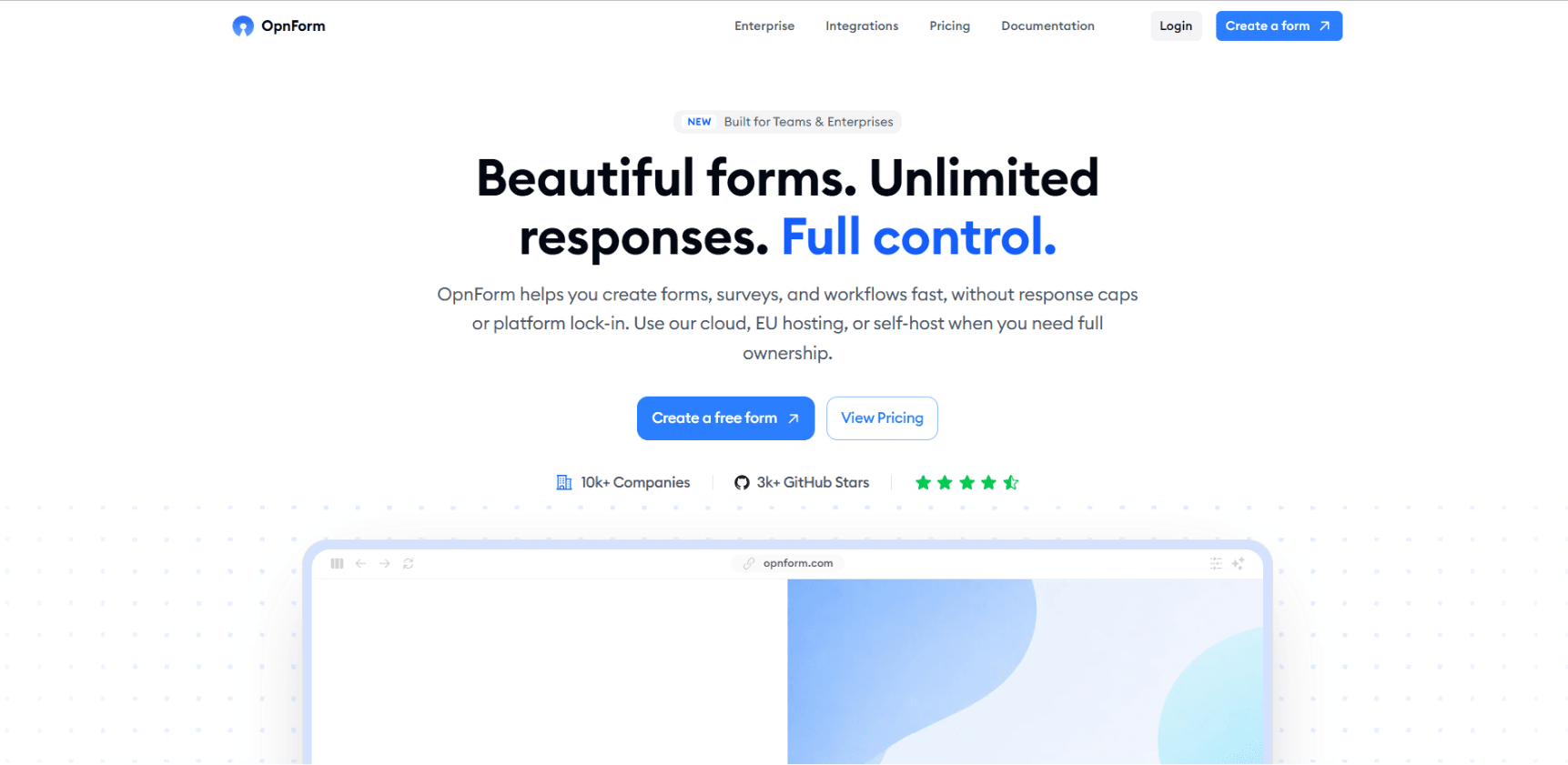
OpnForm is a behavioral form engine built for growth teams who've realized that generic form tools produce submissions, not conversions. We re-architected the form experience around buyer psychology — progressive disclosure, conditional field logic, and embedded social proof — to eliminate the friction points where qualified leads abandon. The result: a capture system that works as hard as your ad spend.

31%

Increase in Qualified Submission Rate

2,400+

Forms Deployed in Production

4.1×

Average ROI on CAC Recovered

01 — Challenge

The problem

A B2B SaaS company running $40K/month in paid acquisition was converting paid traffic to form completions at 3.2%. Industry benchmark for their segment was 7–9%. The gap wasn't targeting or copy — it was the form itself. Long field count, no mobile optimization, and a single static CTA were bleeding 60% of reachable pipeline before it ever entered the CRM. Every unconverted lead represented wasted CAC.

02 — Approach

Our strategy

We approached the form as a conversion funnel, not a data collection mechanism. The primary metric was Qualified Submission Rate — not raw form completions. We applied progressive disclosure: ask for the minimum to create momentum, then layer in enrichment questions post-submission. We embedded micro-social-proof signals at key abandonment points. We optimized every field label, placeholder, and error state for completion psychology.

Solution

What we shipped

We engineered a dynamic form engine with conditional field logic, multi-step progressive flows, real-time field validation with non-punitive error states, lead scoring based on response patterns, and instant CRM push on submission. Forms are embeddable, white-labeled, and load in under 800ms. A/B testing is built-in at the form level — no external tooling required.

  • Progressive Multi-Step Engine

    Conditional branching flows that adapt questions based on prior answers

  • Behavioral Lead Scoring

    Real-time qualification scoring based on field response patterns and time-on-field signals

  • Sub-800ms Embed

    Iframe and native embed options that don't block page rendering or hurt Core Web Vitals

  • Non-Punitive Validation

    Inline field validation with recovery suggestions, not blocking red-screen errors

  • Native CRM Push

    Zero-latency submission routing to HubSpot, Salesforce, and Pipedrive with field mapping

OpnForm product detail

Experience

Designed for clarity at every interaction.

Dashboards

The builder interface is a split-pane live preview: left panel is the field editor, right panel is a pixel-accurate preview updating in real time. No publish-refresh loop. Form analytics are embedded in the builder itself — abandon rate per field, median completion time, and score distribution surface without switching tabs.

User flows

A new form is live in 4 steps: choose a template → configure fields → set routing rules → publish. The end-user completion flow uses a progress indicator that always shows one more step than is complete — a deliberate psychological mechanic to reduce drop-off. Mobile layouts auto-adapt with touch-optimized input targets.

Interactions

Field focus triggers a smooth vertical expansion animation creating perceived momentum. Completing a step produces a subtle checkmark transition before advancing — a micro-reward that reinforces progress. The final submission state uses a full-field success animation with a personalized confirmation message rendered from form data.

Engineering decision

The hard problem we solved

Challenge

Building a conditional logic engine that non-technical users could configure without introducing contradictory rule states or infinite loops.

Decision

We implemented a directed acyclic graph (DAG) model for form flow logic with a real-time validation layer that detects and surfaces contradictions before publish. The visual rule editor uses a node-based UI with constraint checks — users can't create a logic path that leads to a dead end. Invalid states are highlighted before they become production bugs.

Technology

Stack

ReactNode.jsPostgreSQLRedisVercel Edge Functions

Chosen for reliability, speed of iteration, and long-term maintainability.

Takeaway

If your forms aren't converting, the problem isn't your traffic — it's your capture architecture. We engineer forms that qualify, not just collect.

Next case study

Relay

An intelligent automation fabric that eliminates the manual work silently consuming 40% of your operations team's capacity.

Softqix

Ready to build something that scales?

One focused strategy call. We map the outcome, the scope, and the path — then we build.

Request Cost Estimate
  • Strategy call within 48h
  • No retainer lock-in
  • Clear milestones & pricing